
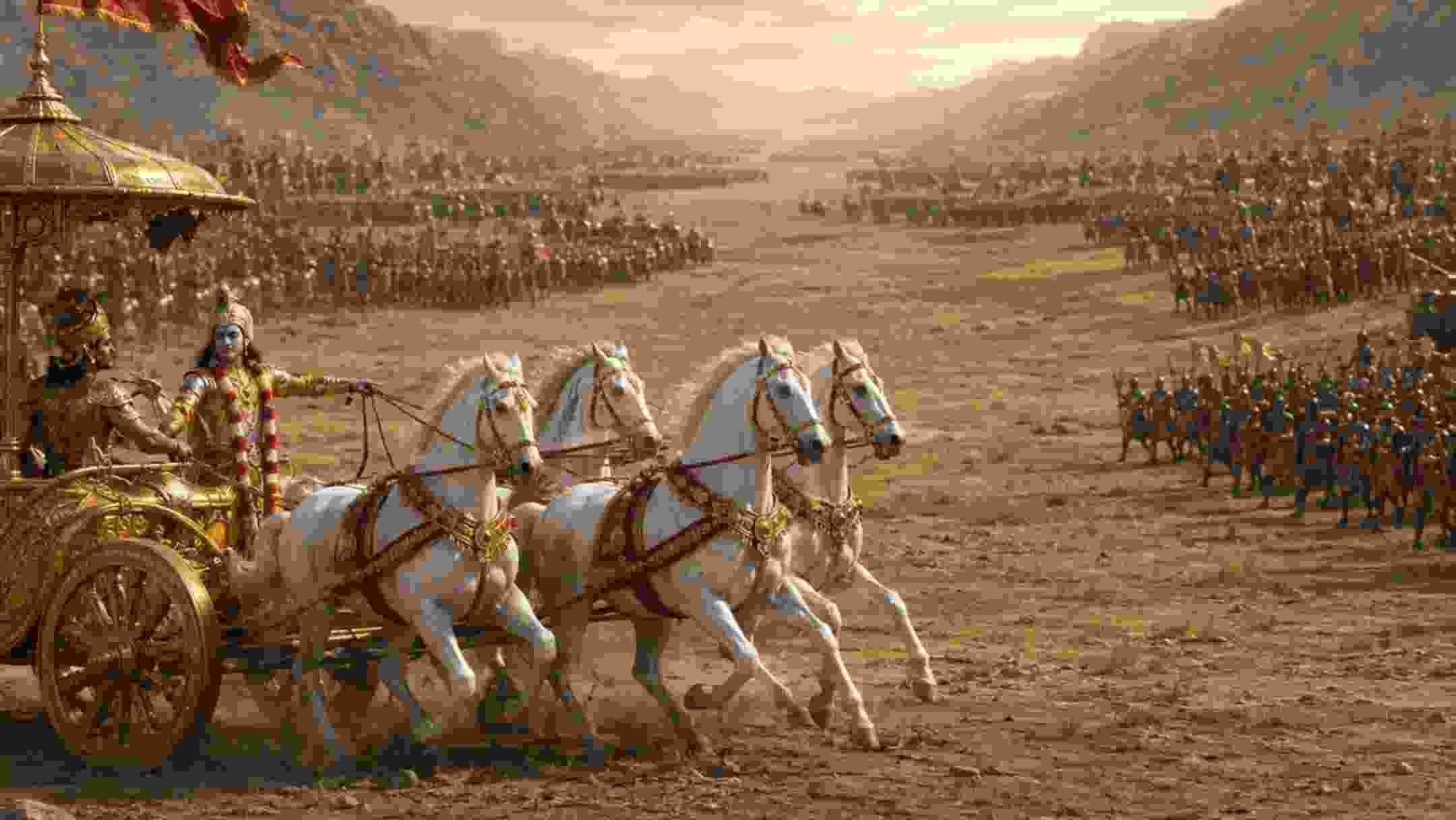
Spiritual knowledge is attained, and yoga is practiced, to achieve the greatest purpose of human life—liberation (Moksha). In this sequence, we will now understand Karma Yoga (Yoga of Action) , the teaching of which is given in the Bhagavad Gita.
A person becomes bound by karma when they perform actions while being attached to the world. Even if they receive the fruits of their actions and their desires are fulfilled, they still fail to attain what was truly worth attaining in life. Therefore, भगवान teaches the path of Karma Yoga so that a person may make their life meaningful.
In Karma Yoga, selfless action (Nishkama Karma) is given importance, whereas desire-driven action (Sakama Karma) is considered extremely inferior because it creates obstacles in the practice of Karma Yoga.
What Is Nishkama Karma Yoga in the Bhagavad Gita?
Seekers, Lord Shri Krishna said to Arjuna: “Arjuna! You have a right only to perform your duty, never to its fruits. Therefore, do not perform actions with the desire for their results, nor become attached to inaction.” This is the meaning of Bhagavad Gita, Chapter 2, Verse 47, and it is a precious teaching of the Bhagavad Gita.
Krishna is teaching Arjuna Nishkama Karma Yoga in order to free him from the bondage of karma and lead him toward spiritual liberation. At the same time, He also says that perfection cannot be attained merely by avoiding action, because the human body is governed by nature, and therefore a person is compelled to act.
When Krishna speaks about action, we must also understand what kind of action He is referring to. Krishna advises Arjuna to perform selfless action.
Put yourself in Arjuna’s place and consider this—you cannot perform every action with complete selflessness. For example, why do people work? They work for money. And what do they do with that money? They either spend it on themselves or on their wife and children so that they may enjoy worldly pleasures. They perform these actions so that their personal interests may be fulfilled. In such a situation, to perform selfless action, one would first have to renounce the very action itself.
The action you are currently performing has self-interest at its center—you began performing it because of self-interest. The reason for its existence is self-interest, desire, or craving; without these, that action would not exist at all. So how can you perform that action with a selfless attitude? The very self-interest that chose the action remains at its foundation.
Trying to perform an action that is centered on self-interest with a selfless attitude is not Karma Yoga—it is foolishness. Ignorant people say, “Perform your actions, but do not worry about the results,” yet they do not explain which action should be performed. However, this is the most important question: the right action must be chosen—that is, selfless action.
If performing an action causes you great suffering, merely refusing to worry about its result will not remove that suffering. You are not required to perform just any action without concern for its result; rather, you must choose the right action. Choosing the right action is called Karma Yoga.
Performing the right action is Karma Yoga—not trying to perform every action with a selfless attitude, because such an attempt can never truly succeed. Only the action that is right, righteous, and one’s duty is selfless.
Which Action Is Right and Selfless?
What the right action is can be understood only when we first understand what the wrong action is, what desire-driven action is, and what kind of action separates us from the Self—an action that is contrary to yoga—and then renounce it.
You can see that people engage in devotion and sing devotional hymns. Why do they do so? They believe that by singing hymns, they will receive God’s grace, gain money and property, have their desires fulfilled, and become free from the suffering caused by their desires or other circumstances. Or they worship so that they may attain a place in heaven after death.
People who think in this way are deeply deluded. Even atheists who deny the existence of God and do not perform such actions are more religious than them.
I am not saying that performing devotional worship and prayer is foolishness, but we must examine why these actions are being performed—is there some lower self-interest behind them?
Before performing any action, one must first examine whether the person performing it is influenced by ego, because whenever a person undertakes an action, there is always some form of self-interest behind it.
How can selfless action be performed without love and surrender? Therefore, love must first arise in the heart—and that love should not exist merely because it fulfills some desire; it should not be false love, but true love. Love should exist because it leads to liberation—because through performing the action itself, we have received everything, become complete, and nothing remains for which we must desire.
It should not be that, under pressure, one thinks, “Nothing is going to be gained from this, but I will still do it—at least you will remember me.” Such action is not selfless action.
The primary purpose of life and the first desire should be the desire to become free from self-interest. Therefore, whatever action is performed should be selfless. Shri Krishna also said that actions should be performed for Lord Vishnu—Vishnu means “supreme freedom.”
Action should not be performed to fulfill self-interest, but to become free from self-interest itself. For this, it is necessary to understand what spiritual liberation is, about which other detailed articles are available.
One must choose the action that will eliminate self-interest. Therefore, first recognize the activities in which you are engaged because of lower worldly self-interest, and then renounce them. In their place, perform actions that create and preserve inner purity. The meaning of Paramartha is also the highest self-interest, but it is a form of self-interest that elevates life above all other trivial interests—an action performed for such a purpose is selfless.
Why Is Nishkama Karma Yoga Important?
People perform actions because they are attached to their results. A person becomes attached to worldly objects because they do not understand their fundamental need. Therefore, they seek to remove their inner suffering—desire, craving, and longing—through actions and their results.
Just as thirst can be quenched only by water and hunger can be satisfied only by food, in the same way, bondage and suffering can be removed only through liberation. However, a person tries to eliminate this suffering by filling it with other things. This is why they chase worldly pleasures and continue performing actions.
Their fundamental need is liberation, but this need cannot be fulfilled by attaining worldly pleasures. In this way, their actions gradually become futile, and even after performing actions throughout their entire life, they do not attain what they truly need or what can bring an end to their suffering.
In the Gita, Krishna says that selfless action is superior to desire-driven action because He knows the defects that arise from it. Actions performed to fulfill self-interest and desires destroy a person’s wisdom, causing their downfall and making them fall from their true state.
Happiness and peace remain within only as long as the mind is established not in worldly objects but in liberation—that is, when action is performed free from the bondage of the mind. Another name for this liberation is spiritual bliss, which is the highest form of bliss.
However, when a person’s goal is only to obtain results, they choose actions through which their naturally free state becomes suppressed beneath worldly objects. This is the first loss. The second loss is that, because of this attachment, a person wastes their entire life, for the race after worldly objects continues until death, yet completeness is never attained.
