
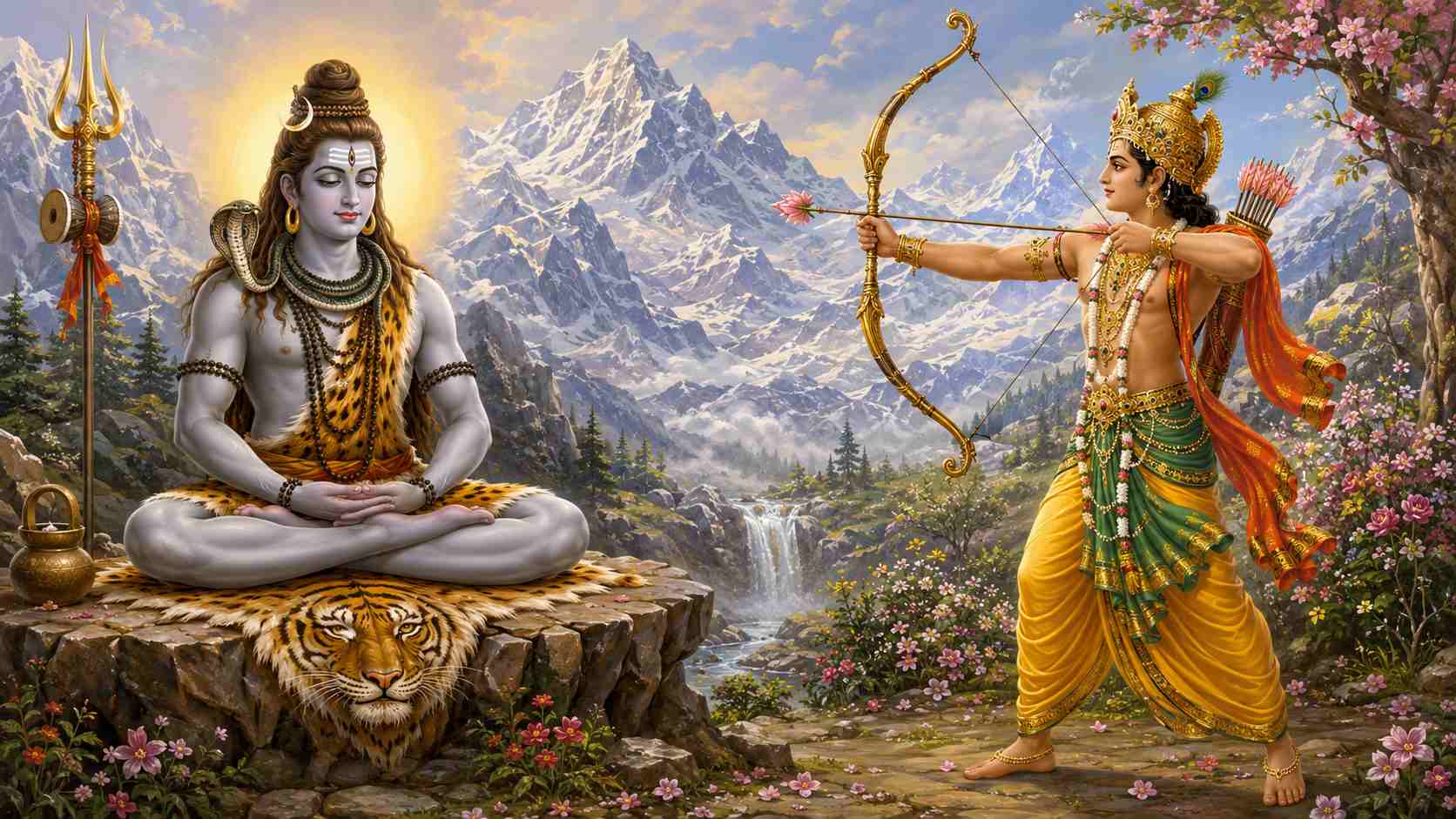
In Hindu tradition, Lord Shiva is revered by the gods and is often portrayed in the Puranic stories as a divine protector who comes to their aid during times of great danger. The story of Shiva burning Kamadeva is found not only in the Shiva Purana, but also in texts such as the Matsya Purana, Padma Purana, and Vamana Purana. The great Sanskrit poet Kalidasa also incorporated this episode into his works.
Although the story is presented somewhat differently in different texts, its deeper meaning is important because it explores the relationship between desire, self-control, awareness, and spiritual discipline.
Why Did Lord Shiva Burn Kamadeva?
According to Hindu mythology, demons often performed intense austerities in order to obtain extraordinary powers or protection through divine boons. Complete immortality, however, is generally presented as impossible: whatever is born must eventually pass away. Even Brahma, the creator within the Hindu cosmic framework, is not described as eternally immortal, nor is the created universe itself.
One powerful demon, Tarakasura, therefore sought a different kind of protection. He obtained a boon that he could be killed only by a son of Lord Shiva.
Tarakasura had deliberately chosen this condition because, after the death of Sati, Shiva had withdrawn from worldly life and become deeply absorbed in meditation. Tarakasura believed that Shiva would never marry again and therefore could never have a son who could defeat him.
With this protection, Tarakasura became extremely powerful and arrogant. He fought the gods and defeated them, leaving the divine beings with very few options for stopping him.
The gods eventually approached Lord Shiva, who was deeply absorbed in samadhi, a profound state of meditative absorption. This created a serious problem for the gods.
At the same time, Goddess Parvati was performing intense austerities with the desire to attain Shiva as her husband. In many Hindu traditions, Parvati is understood to be the rebirth of Sati. Like Sati, she was deeply devoted to Shiva.
However, Shiva had withdrawn from worldly attachments after losing Sati and was not interested in marriage. The gods realized that if Shiva and Parvati could come together, their future son could eventually become the one capable of defeating Tarakasura.
They therefore turned to Kamadeva, the Hindu deity associated with love, attraction, and desire.
Kamadeva attempted to awaken romantic desire in Shiva and interrupt his meditation. According to the story, he transformed the surrounding forest into a beautiful spring-like landscape filled with flowers and the signs of spring. Yet Shiva remained completely unaffected.
Finally, Kamadeva released his famous flower-tipped arrow toward Shiva.
When the arrow reached Shiva, his meditation was disturbed. Shiva immediately understood that Kamadeva was responsible. His anger arose, and in the traditional account, his third eye opened and reduced Kamadeva to ashes.
Kamadeva’s wife, Goddess Rati, was devastated by what had happened. She prayed to Shiva and pleaded for mercy.
Shiva eventually granted Kamadeva a different form of existence. In many versions of the tradition, Kamadeva continues to exist without a physical body, representing desire and emotional attraction within the mind.
Afterward, Shiva was moved by Parvati’s devotion and austerities. He accepted her and eventually married her. Their son, Kartikeya, later became the divine warrior who defeated Tarakasura.
What Is the Deeper Meaning of This Story?
For modern readers, especially younger generations, this story can be understood as a powerful teaching about self-control and awareness.
The important point is not that love itself is wrong. Rather, the story distinguishes between uncontrolled desire and a relationship entered with awareness, responsibility, and deeper understanding.
Shiva does not allow himself to be controlled by desire. Kamadeva’s arrow represents the power of attraction and impulse, while Shiva’s response represents mastery over the mind.
This is why the burning of Kamadeva can be understood symbolically. Shiva is not simply destroying a deity; he is overcoming the power of uncontrolled desire through awareness.
In this sense, the story connects closely with the idea of yoga. Yoga is not merely about physical postures. At its deeper level, it is also concerned with understanding and mastering the mind rather than becoming a slave to every impulse that arises within it.
At the same time, the story does not necessarily teach that marriage or romantic love is wrong. Shiva ultimately marries Parvati—but only after recognizing her devotion and after overcoming the influence of uncontrolled desire.
This creates an important distinction: desire can influence a person, but awareness allows a person to choose how to respond to it.
Relationships based only on physical attraction or temporary desire can become unstable when deeper understanding, respect, trust, and responsibility are missing. A healthy relationship requires much more than attraction.
Seen this way, the story of Shiva and Kamadeva offers a timeless lesson: first learn to understand and govern your own mind; then make important choices from awareness rather than impulse.
Shiva’s marriage to Parvati therefore comes after the symbolic victory over uncontrolled desire. The story presents this as a movement from impulse toward awareness, devotion, and conscious union.
Other Articles:
