
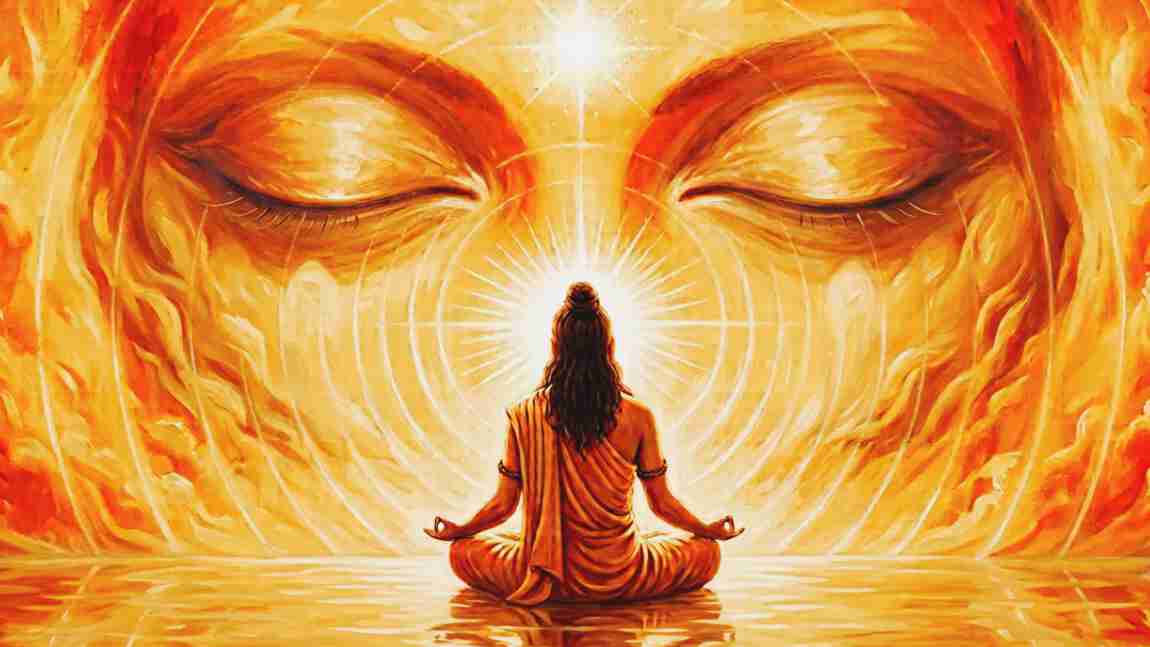
Seekers, what are Para Vidya and Apara Vidya? What is the difference between them? In the Mundaka Upanishad, the learned sage Angirath answers this question when the seeker Shaunaka asks, “By knowing what does everything become known?”
What are Para Vidya and Apara Vidya?
At the very beginning of the Mundaka Upanishad, Shaunaka asks his guru Angirath a question. He asks, “By knowing what is everything known?” This is not an ordinary question. It reveals the deep spiritual inquiry of the disciple Shaunaka.
Shaunaka is a sincere seeker, and he wishes that his guru may reveal to him that fundamental Truth through which the true knowledge of the entire universe is attained naturally. Hearing this question, Angirath begins to explain and first describes the two forms of knowledge: Para Vidya and Apara Vidya.
Angirath clearly explains the nature of these two kinds of knowledge and also elaborates on the fundamental difference between them so that Shaunaka’s inquiry may be resolved and he may progress toward true knowledge.
The Mundaka Upanishad is regarded as an extremely important part of Advaita Vedanta philosophy, and it is counted among the nine principal Upanishads that hold the highest place in the study of Vedanta.
From this very Upanishad comes the eternal teaching, “Brahmavid Brahmaiva Bhavati”, which means that one who knows Brahman becomes Brahman itself.
This statement is not merely a declaration; it may be regarded as the essence of the entire Vedantic philosophy, for it points to the fact that the apparent distinction between the knower and the known ultimately dissolves, leading one to spiritual liberation.
What is the difference between Para Vidya and Apara Vidya?
The word Para means higher, while Apara means lower. Through this distinction, the Upanishad makes it clear that knowledge related to the material world is regarded as lower knowledge, whereas Self-Knowledge is regarded as the higher knowledge.
This classification exists because the purpose and the result of these two forms of knowledge are different. One kind of knowledge helps in understanding the world, while the other leads one toward knowing one’s own Self.
Whatever knowledge can become the object of your senses and your mind—that is, whatever can be experienced through the senses or contemplated by the mind—is called Apara Vidya.
Its object of knowledge is always worldly. Whatever subject the mind can think about falls under Apara Vidya. Science may be taken as an example. Science is worldly knowledge, the knowledge related to physical and material objects. It reveals the laws of the universe, yet it always remains confined within the universe and cannot go beyond it.
However, the Upanishad points toward a knowledge higher than this. Self-Knowledge is considered far superior, and this Self-Knowledge is also called Vedanta. The word “Veda” means knowledge, and “Anta” means the end; thus, Vedanta means that point where all knowledge reaches its culmination, beyond which nothing remains to be known.
This is important because when a seeker attains this Para Vidya, all of his inquiries come to an end, for he realizes that fundamental Reality from which the entire creation has originated.
On the other hand, whatever knowledge is related to the non-Self—that is, everything connected with objects and subjects other than the Self—comes under Apara Vidya. However, the seeker should not misunderstand this to mean that knowing the emotions or thoughts of the mind is Para Vidya. The modifications of the mind, emotions, and even the sense of ego are all considered worldly.
All these belong to the mind and the intellect, and both the mind and the intellect are themselves part of the manifested world. Therefore, the knowledge associated with them also falls under Apara Vidya. Para Vidya, on the other hand, is the movement toward the Supreme Truth, the Reality that lies beyond the limitations of the mind and the intellect.
If a seeker considers this world itself to be the ultimate Truth, that is called ignorance. This has already been discussed earlier in the article: How does the world of Maya arise from your own ignorance and present illusion as reality?
Para Vidya refers to That which is Supreme and beyond everything. It is a Reality that cannot be known because It is not an object of knowledge. For something to be known, it must come within the range of the mind and intellect, but the Supreme Reality lies beyond them. The mind cannot contemplate It, the intellect cannot analyze It, It is inconceivable, It cannot be expressed through speech, and therefore no name can truly be given to It.
You cannot know That, yet it is also true that It knows you completely. This is a profoundly subtle truth because we generally believe that in the process of knowing there is a knower and an object of knowledge. However, in Para Vidya this relationship is reversed. Here the seeker no longer remains the knower; rather, the seeker himself becomes the known.
The realization of the Self becomes possible only when the seeker becomes established in that Supreme Reality through complete surrender.
Through this spiritual discipline, the seeker gradually rises above ignorance and ultimately attains a state of perfect equanimity. This very state is called Samadhi.
This topic has also been discussed in detail earlier: What is Samadhi, what is the true meaning of the state of Samadhi, and how a seeker strives to attain this state.
