
What Are “Namaskar” and “Namaste”?
In Indian culture, we say Namaskar or Namaste to greet someone and to express respect toward them. It is not just a word, but a tradition that we are taught from childhood.
Whenever we meet an elder, visit a temple, or welcome a guest, these are often the very first words that come from our mouths.
Even in the scriptures, there are many mantras in which these very words are used to offer salutations to God. But do you know how deep the spiritual meaning of Namaste really is? And how it contains the essence of Indian philosophy?
What Do ‘Namaskar’ and ‘Namaste’ Mean?
Whether it is Namaskar or Namaste, both contain the word “Namah” (नमः), which means to bow, to offer salutations, or to show respect. The word “Kar” in Namaskar means to do or perform. In Namaste, “Namah” is combined with “Aste”, meaning is. Thus, the literal meaning of Namaste is: “I bow to you” or “My salutations to you.”
Generally, we understand it simply as a way of showing respect to the other person. We use it as a formality, without realizing how profound the idea behind it truly is.
There is also a much deeper spiritual meaning that very few people are aware of. When we say Namaste or Namaskar, it means that we are bowing directly before the purest Self. “Namah” and “Aste” together signify: salutations to that which is real, to that which is truth, to that which is pure consciousness.
This bow is not directed toward a physical body, but toward that true essence which exists equally within every person. It is beyond thoughts and beyond the false identity created by the psychological self.
When we say Namaste to someone, we are actually bowing to that same Supreme Reality within them that also exists within us. This is why Namaste is often associated with the idea:”I bow to the Divine, the true Self, within you.”
The mantra “Om Namah Shivaya” and “Om Namo Bhagavate Rudraya Namah” Mantra offer salutations to Rudra, while “Om Namo Bhagavate Vasudevaya” offers salutations to Krishna. In these mantras as well, the reverence is not merely for an external form, but for the Truth that dwells within.
The Upanishads also repeatedly use the words “Namah” and “Namo” while offering salutations to the Supreme Reality. This is not a new tradition; its roots go back to the ancient Vedic age of India. For centuries, sages and seers have expressed their devotion and surrender to the Supreme through these very words. This tradition has been passed down from generation to generation and remains just as alive today as it was thousands of years ago.
What Is the Difference Between ‘Namaste’ and ‘Namaskar’?
Today, many people often say that Namaste should be used when greeting a single person who is your equal or younger than you.
On the other hand, Namaskar should be used when addressing more than one person or someone who is senior or worthy of greater respect.
This distinction has long existed in our language and etiquette, although today most people use both words interchangeably.
Even in the Bhagavad Gita, when Arjuna beholds Krishna’s Universal Form, he repeatedly offers salutations by saying: “Namo Namaste’stu Sahasrakritvah.”
Arjuna bows again and again—thousands of times—to that Cosmic Form, because it was impossible to contain such infinite greatness within words. That is why he does not stop after offering one salutation, but continues bowing repeatedly. Traditionally, Namaskar has been used before someone or something regarded as supreme or vast.
How Should Namaste and Namaskar Be Said?
Whenever you say Namaste or Namaskar to someone, you should remain humble, because you are expressing respect and offering salutations.
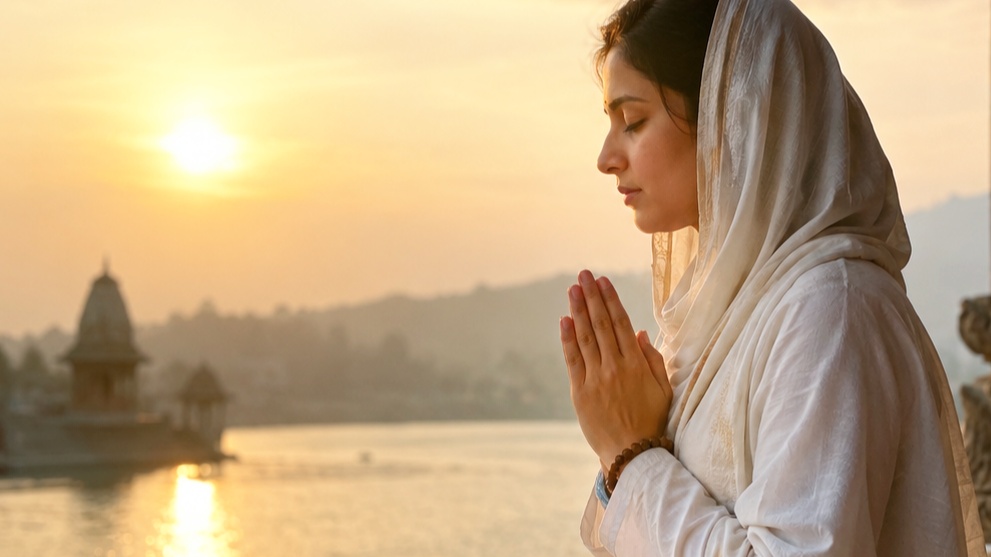
While saying it, you should join both hands together and slightly bow your head so that you may truly embody its meaning.
The joining of both hands itself symbolizes respect.
When we merely say “Namaste” with our lips, without folding our hands or bowing our head, it remains only a word. But when we do it with complete humility, reverence, and sincerity, it becomes a genuine spiritual practice.
Conclusion
It reminds us that we are not bowing to a body or a name, but to the consciousness that dwells equally within every living being.
So the next time you say Namaste to someone, pause for a moment and remember this deeper meaning. It is not merely a greeting, but a living expression of our ancient tradition and philosophy, which teaches us that the same Supreme Truth resides within every person, just as it resides within us.
