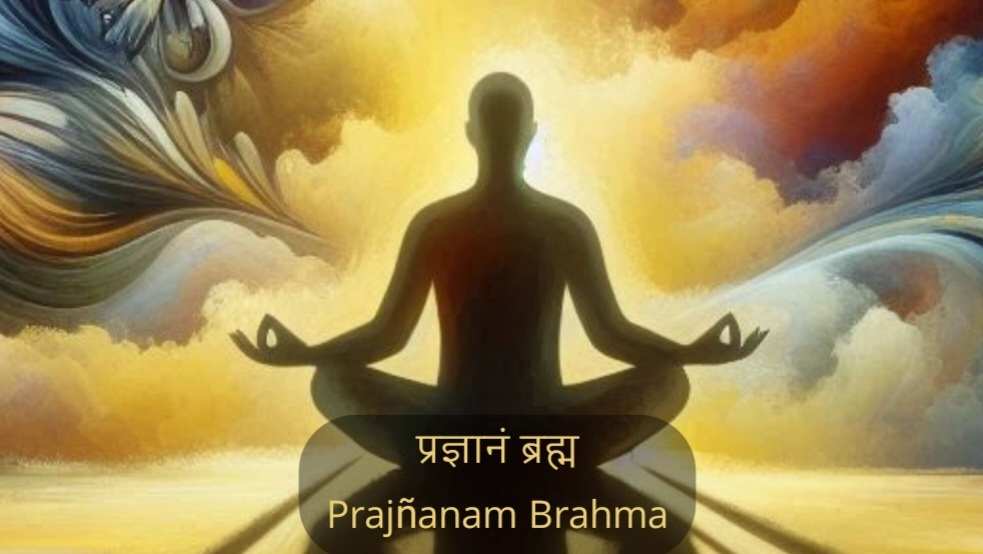
Prajñānam Brahma (प्रज्ञानं ब्रह्म)is one of the four highly significant Mahāvākyas of the Advaita tradition, the systematic philosophical exposition and propagation of which is credited to Ādi Śaṅkarācārya. This Mahāvākya is originally found in the Aitareya Upaniṣad of the Ṛgveda, an extremely ancient and profound spiritual text of the Vedic tradition.
This text was not only beneficial for human welfare in its own time, but it is equally relevant and beneficial today. In fact, it can be said that for modern humans struggling with intellectual and mental conflicts, its relevance has increased even further.
What is the Mahāvākya ‘Prajñānam Brahma’?
The Mahāvākya Prajñānam Brahma contains no story, no symbolic tale, no traditional belief, and no superstition. It is extremely direct, clear, and factual. It consists of only two words: Prajñānam and Brahma. Its direct and concise meaning is that Prajñāna itself is Brahman.
Here, Prajñāna does not mean ordinary information or intellectual knowledge. Prajñāna refers to that complete and integrated consciousness which is complete in itself. That very completeness is the sat, cit, and ānanda nature of Brahman, the supreme reality and Spiritual Bliss. It is not a kind of knowledge obtained through external means; rather, it is that in which all forms of knowing become possible.
Meaning of Prajñāna: Here, knowledge does not merely mean that you are aware of an object, a person, or an idea. Prajñāna means complete knowledge. Complete knowledge implies not only knowing external sensory objects, but also knowing the knower who is aware of these sensory objects.
In the ordinary state, the living being remains connected to the sensory world. It seeks pleasure in sensory gratification, becomes fearful when imagining the loss of existence, and feels sorrow or anger when desires are unfulfilled or when situations are unwanted. Life is spent within the dualities of object and subject, experiencer and experience, known and knower.
This entire sensory world, the living being, and its experiences arise within Prajñāna itself. In other words, the world and its experience have no independent existence separate from Prajñāna.
The non-dual relationship between the living being and consciousness: The entire existence of the living being is situated within consciousness. This consciousness is indivisible and undivided. The same consciousness pervades you, me, and all living beings equally. All beings exist within this consciousness, and this consciousness is present in all beings.
This itself is pure non-dual reality. This itself is Brahman. The Mahāvākya “Ayam Ātmā Brahma” also points to this same truth, that the inner reality and Brahman are not two, but are two names for the same supreme reality.
Knowledge of the world and the understanding of Prajñāna: The living being is constantly knowing the world. Its entire life proceeds within the process of knowing. For example, consider a working employee. Upon waking in the morning, there is awareness of time, then awareness of daily duties, then while stepping outside, the search for transport, and at the workplace, numerous decisions are made. From morning to evening, one continuously remains within knowledge.
However, this knowledge is worldly knowledge obtained through the senses, memory, and intellect. Prajñāna is different from this. Prajñāna is that in which not only is the world being known, but it is also known who the knower of the world is, and why that knower wishes to remain connected to the world.
Why Prajñāna has been called complete knowledge: For this reason, Prajñāna has been described in simple language as complete knowledge Self Knowledge. Most people spend their entire lives knowing only the external world. They accept as truth only that world which appears through their senses and mind. The basis of this world is the bodily senses and the mental field.
But they fail to recognize that the consciousness in which all this appears is the actual reality. Prajñāna is beyond the senses, mind, and intellect. Only by abiding in it does liberation become possible. When a seeker becomes established in Prajñāna, bondage naturally begins to dissolve.
The complete verse of Aitareya Upaniṣad and its meaning
The complete Sanskrit verse of Prajñānam Brahma is found at the end of the third section of the Aitareya Upaniṣad. This verse establishes the entire universe as non-separate from Prajñāna.
Eṣa brahma eṣa indra eṣa prajāpatiḥ ete sarve devā imāni ca pañcamahābhūtāni pṛthivī vāyur ākāśa āpo jyotīṁṣīty etāni imāni ca kṣudramiśrāṇīva | bījāni itarāṇi ca etarāṇi ca āṇḍajāni ca jārujāni ca svedajāni ca udbhijjāni ca aśvā gāvaḥ puruṣā hastinaḥ yat kiñcedaṃ prāṇi jaṅgamaṃ ca patatri ca yaccasthāvaraṃ sarvaṃ tatprajñānetraṃ prajñāne pratiṣṭhitaṃ prajñānetro lokaḥ prajñā pratiṣṭhā prajñānaṃ brahma ॥
Meaning: This verse states that this is Brahman, this is Indra, this is Prajāpati. All the deities, the five great elements, and all living beings, whether born from eggs, from the womb, from moisture, or from the earth, whether humans, animals, birds, moving or unmoving beings, all are endowed with the eyes of Prajñāna and are established in Prajñāna.
The entire world is situated in Prajñāna. Prajñāna alone is its foundation. The final conclusion given is that Prajñāna itself is Brahman.
Conclusion:
Thus, the Mahāvākya Prajñānam Brahma does not teach the acceptance of a new deity. Rather, it reveals that the consciousness by which everything is known is the supreme truth itself. When this truth becomes experiential, duality dissolves on its own, and the living being recognizes its real nature. This is the essence, purpose, and non-dual message of this Mahāvākya.