
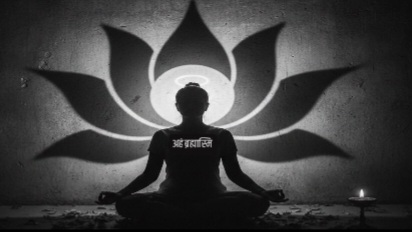
What is “Aham Brahmasmi” Statement ?
We are explaining the teaching of the Mahavakya “Aham Brahmasmi” here in detail, so that you may understand it not only at an intellectual level, but also at the level of the heart and direct experience.
What message this Mahavakya gives you, and how deeply you assimilate it, can be extremely important for your life. Because when you understand its truth, you begin to live life exactly as the universe has given it to you. Only then does the experience of love and compassion of the all pervading supreme reality become possible for you.
Among the four Mahavakyas of the Advaita tradition, “Aham Brahmasmi” is one of the most significant. Its propagation is attributed to Adi Shankaracharya, but its original source is the Brihadaranyaka Upanishad of the Shukla Yajurveda.
This statement appears extremely brief, yet it contains within itself infinite and profound spiritual knowledge. Its commonly given translation is “I am Brahman.”
Here Brahman does not mean any assumed external deity or form, but the supreme pure consciousness that manifests as awareness within you, me, and all beings, and which is Atman. It is that independent transcendental nature which is free from material attachments and bondage, and which is complete Spiritual Bliss and supreme experiential realization. This is true Self realization. The second Vedantic Mahavakya “Prajñanam Brahma” also conveys the same teaching, that precise awareness of life and existence itself is Brahman.
The literal meaning is as follows:
Aham means I.
Brahma means the cosmic, non dual, eternal reality that is beyond the limitations of body and mind.
Asmi means am.
What does the statement “Aham Brahmasmi” truly teach us?
Generally, a human being does not remain established in their true nature of blissful Atman, but instead fills themselves with the material world. They consider themselves limited only to the gross physical body. The individual being regards the body as the experiencer and the world appearing as objects of the senses as something to be consumed. In this way, the center of consciousness becomes the body and ego.
It is true that the external world is useful for fulfilling the needs of the body, but there is something that can never be obtained from this world, yet is absolutely essential for you. That is true joy. That is completeness. That is purity. That is dharma. That itself is Brahman.
People living in the world remain unaware of the truth that the joy and inner peace they keep searching for outside is not located anywhere externally, but exists within themselves. This is exactly like a person who has a necklace around their neck yet keeps searching for it everywhere. When they are told that the necklace is already around their neck, they only need to see and understand.
Brahman is the highest state of consciousness, referred to as supreme consciousness. In this state, duality dissolves, and only the non dual, undivided cosmic existence remains. In this state, the yogi experiences unity with the universe and realizes that the individual and the universe are not actually separate. For this reason, some yogis also explain “Aham Brahmasmi” as meaning “I am the universe.” In this state, the practitioner abides in themselves. This is the highest attainment of meditation. It is samadhi. It is the direct realization of complete reality and truth.
This truth cannot be fully understood through words alone. Spirituality is not a form of knowledge that can merely be stored in the intellect. It is a matter of direct experience. It is realized only when a person rises above the movements and play of the mind and, in complete awareness, directly realizes the meaning of “Aham Brahmasmi.”
A question arises that if Brahman is blissful and peaceful, and if that is what I am, then why is there so much suffering in life?
Here it is necessary to understand that not every person is established in Brahman in their lived experience. This knowledge emerges from the depths of meditation, spirituality, and philosophy.
Most people are not practitioners of meditation. They identify themselves with the waves arising in the mind, whereas those waves are connected to the body and ego. Brahman is the freedom from this identification. In reality, existence is only you, meaning Atman, and this Atman itself is Brahman. In Vedanta, this is taught through the Mahavakya “Ayam Atma Brahma.”
Apart from this Brahman or Atman, there is nothing else. Due to ignorance, distinctions appear. In reality, you, I, and the world are not separate from one another. Everything is illumined within Atman itself. This appearance of separation arises only due to the illusory and sense bound understanding of the senses.
Know this as Advaita. This state itself is called liberation while living. The Mahavakya “Aham Brahmasmi” points toward that liberated Atman, which is beyond the body and free from the bonds of birth, change, and death.
how does this I / Self become established in Brahman?
Through spiritual practice, consciousness attains an upward movement. This is explained through the seven chakras of meditation and the path of Kundalini Yoga. The method of “Neti Neti,” meaning not this, not that, teaches that Brahman is beyond conceptual understanding. This meditative approach is used to cut the bonds of Maya and to become established in Brahman.
The method of abiding in pure consciousness and knowing oneself must be discovered by you alone, because no one else knows your bondage. Only the one who knows is the seeker, and that very knower is the one qualified for liberation. Otherwise not. The Mahavakya “Tat Tvam Asi” also conveys this same teaching, that you are That Brahman.
The ego or identity that is centered on the body and connected to the world is bound to undergo distortions. Whether its relationship with the world is attachment, aversion, or rejection, such an ego is not Brahman. It is an illusion arising in the mind, called the modification of ignorance. Its resolution is possible only when it is clearly recognized.
The yogi who proclaims “Aham Brahmasmi” has risen above the world. They remain established in complete awareness. From this awareness, they recognize all illusions and dissolve them.
In the Yoga Sutras, yoga itself is described as abiding in Brahman. Maharshi Patanjali’s statement “Yogas chitta vritti nirodhah”is truly a message of being established in Brahman. The final goal of the path of devotion is also the realization of Brahman, because that itself is the Brahman nature of Lord Vishnu.
If a seeker is genuinely serious about inner peace and the search for truth, then the realization of Brahman is neither impossible nor miraculous. It is a discipline. It is a journey that does not move outward, but inward.
