
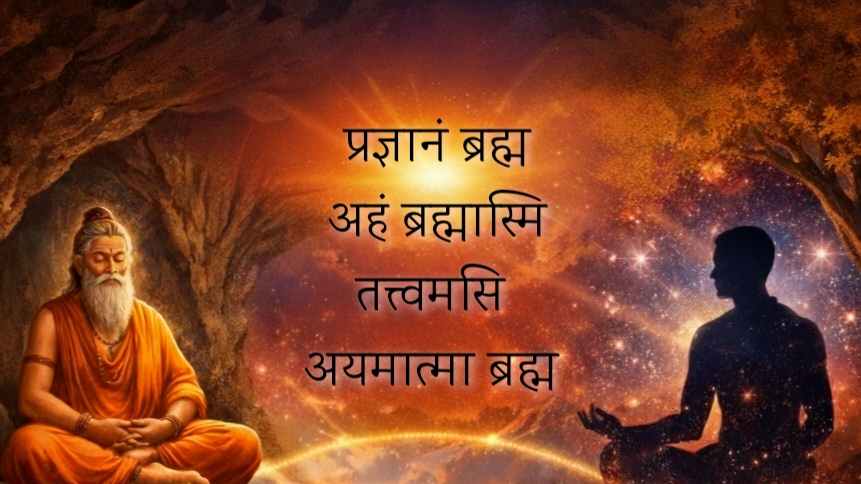
“The article touches the inner journey of self-realization through the Four Mahavakyas of Advaita Vedanta, where the seeker moves beyond the limits of body and ego to recognize pure consciousness. It gently reveals the unity of Atman and Brahman in an experiential and heartfelt manner”
Four Mahavakyas and English translation
Prajnanam Brahma (प्रज्ञानं ब्रह्म)
(Pure consciousness or awareness itself is Brahman)
— Aitareya Upanishad (Rig Veda)
Aham Brahmasmi (अहं ब्रह्मास्मि)
(I am Brahman)
— Brihadaranyaka Upanishad (Yajur Veda)
Tat Tvam Asi (तत्त्वमसि)
(That Brahman is you)
— Chandogya Upanishad (Sama Veda)
Ayam Atman Brahma (अयमात्मा ब्रह्म)
(This Atman itself is Brahman)
— Mandukya Upanishad (Atharva Veda)
What are the Four Mahavakya of Vedanta philosophy?
The complete essence of Advaita Vedanta, its deepest secret and its living truth are contained within these four Mahavakyas. When a person begins to understand them, the journey of realizing oneself begins right there. This journey does not move outward. It does not lead to achievements, powers, or positions. Rather, it slowly brings you back to your own true nature.
In this world, every individual carries a distinct identity. Some are known by their name, some by their profession, some by their relationships, and some by their ideas. Yet the center of all these identities becomes the human body itself. We live considering ourselves to be the body, and on this assumption we build our entire world.
But in reality, this identity is not the truth. This is not something to be known through logic, but through awareness. Yes, for living in the world this identity is useful and necessary for practical dealings, but it is not your true identity. The question of who you are is not merely philosophical. It is the most fundamental question of life itself. And the direct answer to this question is given clearly in the four Mahavakyas of Advaita Vedanta.
This is not imagination, not belief, and not a mental concept. It is a matter of direct realization, a realization that happens within oneself.
We associate our identity with the body. This is the fundamental mistake. Because of this mistake, human beings keep wandering in the world. No matter how much wealth one has, how much power, comfort, or luxury one possesses, until the realization of one’s true nature arises, there remains a subtle dissatisfaction and suffering within.
This suffering does not come from outside. It comes from ignorance. And this ignorance repeatedly leads us back to the same pain from which we wish to escape.
What do the four Mahavakyas of Vedanta point toward?
‘Aham Brahmasmi’ Definition
Aham Brahmasmi means I am Brahman.
Here, the word aham does not refer at all to the ego that is formed by observing, understanding, and adopting the material world. It is not the ego built from name, form, status, knowledge, or authority.
Today, many people begin to say that they are not the body and that they are Brahman. But if this remains only a thought or a statement, then it is as false as believing oneself to be the body. It merely replaces the old ego with a new one.
The intention of this Mahavakya is not to grasp a new identity. Its indication is that the one you have been calling I until now is not truly you. When this false sense of I becomes clear, only then does the journey toward Brahman truly begin.
And it is this journey that carries you beyond this world of suffering. Because what is needed is not freedom from the world, but freedom from ignorance.
Brahman cannot be known as an object. There is no need to know the Truth. There is only a need to see what is false. The moment the false becomes clear, the Truth reveals itself on its own.
Trying to know Brahman through imagination is the greatest mistake. Brahman is not an object to be constructed by the mind. Only the one who has assumed himself to be something needs to be questioned. Because in life, the only thing truly worth realizing is that. If that is not realized in this life, then nothing has truly been realized.
Read more about aham Brahmasmi Mahavakya
‘Prajnanam Brahma’ Definition
Prajnanam Brahma means pure consciousness.
It is that awareness which is completely pure and complete in itself. It is not the consciousness limited to thoughts, memories, or the activities of the brain.
In ordinary language, consciousness is often understood as the waking state or the ability to think and understand. But in the spiritual tradition, consciousness is described as the fundamental nature of Atman, present in every state. Science confines consciousness to the processes of the brain, whereas spirituality speaks of a consciousness that exists beyond both mind and body. That is Prajna, pure awareness itself.
This is the state where the knower, the process of knowing, and the known dissolve into one. This is Prajnanam, and this itself is Brahman.
Read more about Prajnanam Brahma Mahavakya
‘Tat Tvam Asi’ Definition
Tat Tvam Asi means that Reality is you.
This statement is not addressed to someone standing outside. It is spoken directly to the seeker. It is not meant for a particular person or group, but for every conscious being who longs to know the Truth.
The Upanishads clearly state that what you seek outside, what you call the supreme Reality, is not separate from you. It is you yourself. It is the same consciousness that exists as the witness behind the body and the mind.
The sense of difference appears only because of ignorance. In reality, the seeker and Brahman are not separate.
Read more about Tat Tvam Asi Mahavakya
‘Ayam Atman Brahma’ Definition
Ayam Atman Brahma means this Atman itself is Brahman.
The word this is extremely significant here. It does not refer to a distant state or a future attainment. This Atman, which is present right now, is Brahman itself.
Atman and Brahman are not different. What you call pure conscious Atman is Brahman itself. There is no distance, no duality, and nothing left to be attained.
When this realization becomes clear, the search comes to an end. The seeker understands that the one who seeks and that which is sought are not two.
The purpose of spirituality is not to turn you into any supernatural entity. Its purpose is only to establish you in Truth. The false structures we create out of self-interest, fear, and desire may give us things in the world, but they take us away from ourselves. And distance from oneself is suffering itself.
