

Discover the profound wisdom of the Upanishads through the Mahāvākya “Tat Tvam Asi” – “That Thou Art.” This ancient teaching reveals that the ultimate truth is not outside, but within each of us. Learn how self-realization, inner awareness, and understanding your true nature lead to lasting peace, bliss, and liberation from worldly illusions.
What are the verses of “Tat Tvam Asi”?
The Upanishads are considered the supreme peak of the Vedas, that is, of knowledge. The truth, values, self-realizations, and deeply experienced spiritual mysteries that the Indian sages wove into words—its essence is revealed in the Upanishads.
The great saying “Tat Tvam Asi”—described in the Chhandogya Upanishad associated with the Samaveda—whose simple meaning is often taken as “That Thou Art,” actually contains a very subtle and expansive meaning.
Here, “Tat” does not refer to any ordinary form or object; “Tat” points to that Supreme Truth, that ultimate reality, which the sages realized through direct experience. The essence of the Mahāvākya is that the same Supreme Truth, the same Supreme , the same ultimate foundation—you are that.
It is difficult to explain or grasp this profound meaning in just a few words. Therefore, to understand the real import of “Tat Tvam Asi,” it becomes essential to understand oneself.
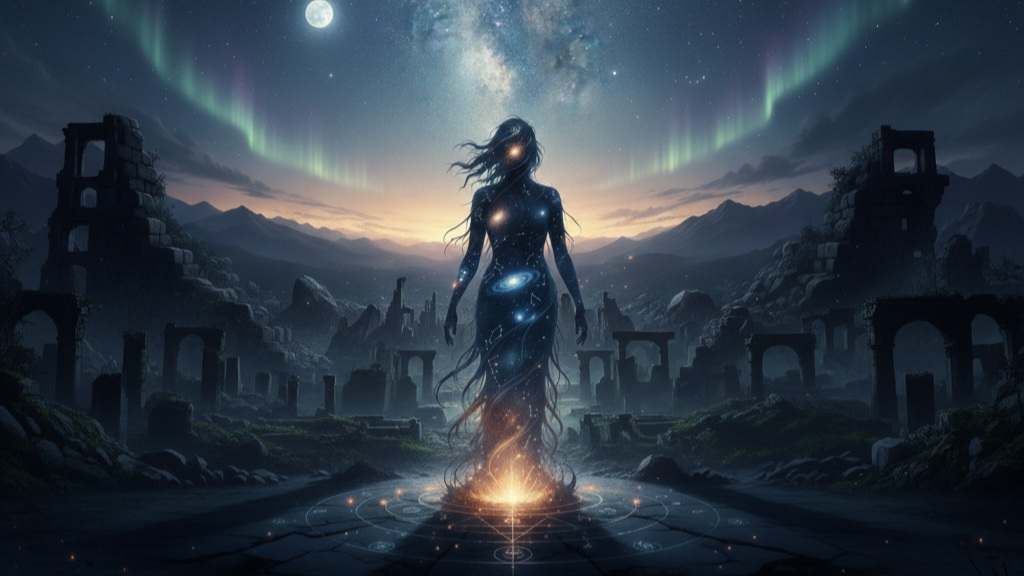
Tat Tvam Asi (You are That)
A person keeps searching for truth in the outer universe, but the Upanishads say: look within yourself—the real foundation, the real peace, the real bliss is present there. Therefore, its detailed contemplation is necessary.
The sentence used in the Upanishads, “Tat Svayam Āsī” also repeats the same truth—Tat, meaning the Supreme. But a question arises: what does Tat indicate? The sages described nature as a group of the five great elements—earth, water, fire, air, and space. These very five elements form the basis of our body. Our senses perceive these elements, science measures these, and our experiences operate within them.
But the Upanishads say that the Supreme is not any of these five. These are only the elements at the level of nature, from which the body is made and on which the experiences of mind and consciousness depend.
The Supreme —Tat—is the source of all these, but is not confined within them. Our eyes are formed from the five elements, so they can see only physical elements. Our consciousness, at its present level, can know only what lies within the limits of the five elements.
Therefore even modern science cannot know Tat, because science studies the physical realm, whereas Tat is not a physical existence. It cannot be measured like a substance, nor grasped by any instrument.
Thus if the question arises—what is Tat—the Upanishads say: it is not necessary to sit and argue about it. That which our senses cannot know, whose knowledge lies above the domain of the mind—thinking about it is itself limited.
But this does not mean that Tat is impossible for us. Even if it cannot be known by intellect, one can merge into it, dissolve oneself into that Supreme Consciousness—and only then does one find liberation from all the suffering that arises from the five elements.
The second part of the Mahāvākya, “Tvam Asi” says that you are that Supreme . The same ultimate truth, the foundation of the entire universe, beyond pleasure and pain, complete in itself—that is your true nature.
But it is very important to understand here that ‘you’ does not mean the body or the mind. Your physical body, your ever-changing mind—this is not ‘you’. Mistaking these as the ‘I’ is the very cause of wandering in the world. Clinging to these is the reason for suffering. As long as we consider ourselves to be body and mind, we cannot become one with Tat.
Here ‘you’ means—the root of your consciousness, that center where you find rest from the turbulence of the world. That is your true nature. That is the Supreme, beyond all incompleteness, and it is not anywhere else—it is within you.
If you are restless, suffering, wandering in the world, the cause is not outside. The cause is yourself—your wrong beliefs, the boundaries you have created for yourself.
The truth is that your real nature is of supreme bliss. Therefore, it is necessary to see which false beliefs cause your suffering, which illusions bind you in sorrow. The Upanishads say—recognize them and gradually remove them.
To attain Tat, to cut through the false, the Upanishads prescribe a very famous method—“Neti Neti,” meaning “not this, not this.”
This means: whatever is grasped by the senses, whatever experience comes to the mind, whatever thought arises—examine each of them: “Is this me?” and the answer will be—“Neti. Not this.” Body—Neti. Mind—Neti. Emotions, thoughts, experiences—Neti. Through this continual discrimination the layers of illusion fall away, and ultimately that alone remains which is real—Tat.
Tat alone is the fountain of bliss.
In this world people wander outside to erase their inner suffering. Some seek peace in objects, some in relationships, some in achievements. But how can an inner lack be fulfilled from the outside?
The true source of bliss is not outside—it is in spirituality, in knowing oneself. Until a person recognizes their real nature, they remain unsatisfied no matter how much they strive.
Indian sages did not keep this knowledge for themselves. For the welfare of society, for guiding the coming generations, they composed the Upanishads. This knowledge is just as available today as it was thousands of years ago. Only one thing is needed—that we receive it and benefit from it.
The mantras of the Upanishads show a person the path to themselves. And ultimately, this is the greatest welfare—to find oneself, to realize one’s original nature, to know that which was always within and will always remain.
